
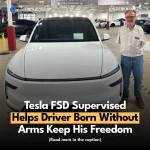
Most people see Tesla as a company focused on technology and sustainability, but for some drivers, the biggest impact is accessibility. John F., who was born without arms, shared that he has driven with his feet for his entire life and has remained a fully licensed driver through it all. He said his usual method was simple but demanding: his left foot handled the steering wheel, while his right foot worked the accelerator and brake. That approach gave him independence, but it also placed a constant physical burden on his body.
As the years passed, John said that burden led to significant arthritis in his hips. He explained that his Model 3 helped extend his independence, but upgrading to a Model Y with FSD Supervised changed things in a much bigger way. In his words, it has been “a complete game changer for me” because it helps reduce the strain and fatigue of daily driving. Stories like his highlight a broader point that advanced driver-assistance systems can offer real mobility benefits for disabled drivers, not just convenience.
“I was born without arms and have driven with my feet my entire life. I’m a fully licensed driver, and traditionally I drove with my left foot on the steering wheel and my right foot handling the gas and brake. My only legal restrictions are automatic transmission and power steering.
Over the years, though, the strain from my congenital birth defects has led to significant arthritis in my hips. I drove a Model 3 for the past seven years, and it honestly helped extend my independence in a huge way.
Recently upgrading to the Model Y – along with Full Self-Driving – has been a complete game changer for me.
It dramatically reduces the physical pressure and fatigue of driving and has helped preserve a level of freedom and mobility that means a great deal to me.
Most people understandably think of Tesla in terms of innovation or sustainability, but for some of us, this technology truly becomes life-changing accessibility.”
– John F.